Tuesday, January 22, 2008

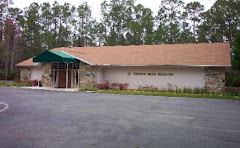
Temple Beth Shalom Adopts a Road


City of Palm Coast's John Harney Installs Sign Indicating
Temple Beth Shalom's Adopt A Road


The Palm Coast Adopt-A-Road program is a litter reduction campaign designed to remove liter and debris from city thoroughfares and improve the quality of the local and regional environments. The program has established a partnership between the City of Palm Coast and Temple Beth Shalom to keep a mile of Pine Lakes Parkway free of litter, attractive and environmentally sound. Temple Beth Shalom, representing the Jewish community of the area has welcomed the opportunity to contribute to community beautification and earn recognition for a job well done.

Beth Shalom has an important interest in saving taxpayer dollars, raising public awareness of the costs of littering, improving the environment, promoting civic responsibility and pride and providing assistance to the governmental agencies responsible for litter clean up. Every day, the City of Palm Coast strives to meet and exceed the needs and expectations of residents and business in our community while respecting and appreciating the environment. Keeping local roads free of garbage and debris is one of many ways a house of worship can contribute to the shared vision of creating a healthy community.

It is well understood that garbage and debris or roadside litter is unappealing to the eye for residents, motorists, guests, visitors and tourists as well as harmful to the environment, obscuring Palm Coast’s natural beauty. Roadside litter can be harmful to animals that consume it, plug or block water drainage systems and present safety concerns for both drivers and pedestrians.

Wednesday, January 16, 2008

Palm Coast Transitions Explained by Mayor Netts at February 10th Temple Breakfast


In just the past 90 days, five Palm Coast city officials have assumed new offices, Vice-Mayor Alan Peterson, re-elected City Council Member Mary DiStefano and two new Council Members, Holsey Moorman and Frank Meeker as well as Mayor Jon Netts who will be the guest speaker at a Temple Beth Shalom Men’s Club Breakfast open to the public on February 10th at 10 a.m. at the congregation’s Wellington Drive synagogue. All are welcome, advance reservations are encouraged but not required. The event includes a sumptuous breakfast for $10 each adult while there is no charge forchildren under the age of 18.

Mayor Jon Netts serves as a Director of the Palm Coast Historical Society; as a Director of Enterprise Flagler, and on the Executive Board of Flagler Habitat for Humanity. He has served as Chairman of the Flagler County's "Citizen Advisory Committee on School Impact Fees" and on the "Flagler County Blue Ribbon Landfill Advisory Committee." He is a graduate of "Leadership Flagler." In November, 2006 Mr. Netts was appointed by Gov. Jeb Bush to the Northeast Florida Regional Planning Council.

The Men’s Club of Temple Beth Shalom has been established to serve the Palm Coast community, enrich the spiritual life of neighbors both near and far. The Men’s Club seeks to create a sense of fellowship and warmth among people of all ages. The Men’s Club of Temple Beth Shalom enjoys the fellowship and kinship that derive from a variety of activities such as celebrating holidays together, laughing together and studying together. Members have found a home away from home where friendly people are always eager and willing to help couples, single parent families, senior adults, interfaith marrieds and newcomers to our community. The Men’s Club makes Temple Beth Shalom, the center of Jewish life in Flagler County, a place where everyone counts!

Tuesday, January 8, 2008

Yad B'Yad Teens Celebrate Chanukah at Shapiro Home


As the move to use the synagogue as the setting for more and more Jewish rituals gains momentum, the People of the Book tend to loose sight of the fact that the equivalent of a church in Judaism, the main source of religious observance, is not the sanctuary but rather the Jewish home. Many Jews try to move their religious observances into the synagogue while the desired outcome that most strengthens Jewish identity and commitment is the move of rituals from the synagogue into the home.


With this in mind, Yad B'Yad teens of the Flagler County Jewish community gathered in a home, the home of Robyn and Rabbi Merrill Shapiro to celebrate Chanukah with traditional foods, games and rituals.


The students enjoyed a meal of potato latkes with applesauce and sour cream and some just old plain "down time" to sit and enjoy each other, to talk and strengthen their connections.

Sdeh Shalom Program Brings Afternoon Worship to Flagler County


As the sun began to set in the western sky, 17 members of the local Jewish community gathered to take a moment out to acknowledge the presence of the Almighty in northwest Flagler County. Temple Beth Shalom is offering an afternoon Mincha service each and every Tuesday at 5:30 p.m. at the congregation’s Sdeh Shalom site on Old Kings Road, just north of Matanzas High School. All are welcome to attend. Mincha is an oasis of spiritual time in a tough day, a moment of calming nerves and focusing on priorities.
Jews are bidden to pray three times daily to God. The Shacharit prayer takes place in the morning. It is the longest of the three daily prayers and contains within it the basic affirmations of Judaism -- the Shema, the Amidah and the ideas of repentance, self-improvement and loyalty to God and Israel.
The Maariv prayer takes place at night, after sunset. It is much shorter in length than Shacharit, but nevertheless includes again within it the basic Shema and Amidah prayers.
The shortest prayer service of the day takes place in the afternoon, or at least just before sunset, and is called Mincha. It is composed of the recitation of Psalm 145, the Amidah, a prayer of repentance and the concluding prayer to all Jewish prayer services, Aleynu. Aleynu is a reaffirmation of Jewish goals and a hope for the better world for all humankind.
Mincha is usually a 10-to-15-minute prayer service, but for much of the Jewish world, it has become almost a forgotten prayer service. It is not the length of Mincha that has caused this, but rather its inconvenience in coming in the middle of a busy working afternoon. But in that fact alone lies perhaps its major importance and necessity.
IN THE FIELD
Our Sages attribute the origin of our three daily prayer services to our patriarchs, Abraham, Isaac and Jacob. Abraham created the prayer time for Shacharit, Isaac for Mincha and Jacob for Maariv.
The rabbis of the Talmud deduced the role of Isaac in creating Mincha from the verse in the Torah that tell us that "Isaac went out to converse in the field" (Genesis 24:63-65). Converse with who? The Torah itself is silent on the subject. The rabbis are of the opinion that the conversation was between Isaac and God. And since the Torah describes this event as happening "before evening," Jewish tradition placed the time of Mincha as being in the afternoon before the time of the sun setting.
Mincha is also connected with being "in the field." Shacharit and Maariv are possible to be prayed outside of the time constraints of our mundane everyday tasks. Not so Mincha. It stops us in the middle of work, shopping, school, and all other usual tasks that life places upon us. It meets us "in the field," at our desks and in our factories -- and it is always inconvenient. But it is an oasis of spiritual time in a tough workday, a moment of contemplation, a calming of nerves and a focusing of priorities. As such, it is perhaps the most important and meaningful prayer service of the day.
NEIGHBORHOOD GROUPS
Today, there are many "Mincha" prayer groups in companies, stores, colleges, hospitals and in geographic areas of cities where a considerable number of observant Jews are to be found.
A lawyer many decades ago in downtown Chicago, observes that there were few if any such "Mincha" prayer groups. He would lock myself in his office, tell his secretary that he was making an important private call, and pray. (Yes, he was placing a personal call to the Almighty.) . Many times he felt a sense of rejuvenation and exhilaration after this 15-minute prayer break. It helped him to overcome the disappointments and frustrations that are the daily lot of all of us at our places of work.
What is lacking in much of current Jewish life, even amongst those who are nominally affiliated with synagogues or Jewish organizations, is a sense of personal participation in Judaism, its rituals, values and blessings. There are members but not participants. No sermon, article, book, class, etc. can connect one to being truly Jewish and feeling so in one's inner soul to the extent that a simple Mincha prayer in the midst of a busy afternoon at the office can.
Mincha becomes a major component of experiencing spirit and holy transcendence in daily human life. It can literally change the way we think about people, the world, life, ourselves

Palm Coast Students Complete Read Hebrew America/Canada Course


Ten Flagler County students were caught up in the National Jewish Outreach Program’s Read Hebrew American event, one of over a 1000 classes across the continent reaching more than 12,000 students intent on acquiring access to the ancient Hebrew documents that guide western civilization. The ten, meeting at Temple Beth Shalom on Thursday evenings, were part of a mega Hebrew literacy campaign that invited thousands of Jewish adults into community institutions to create awareness of the importance of Hebrew literacy. In just five 90 minute sessions, students were given the key to reading with beginning level comprehension the language of the Bible and of a myriad of historical documents dating back 2,500 years.

The National Jewish Outreach Program is an adult education and outreach organization founded in 1987 by Rabbi Ephraim Buchwald, a leading American rabbi then serving at the Lincoln Square Synagogue in midtown Manhattan, New York City. The program’s aim is to address issues of Hebrew and Jewish literacy.

Temple Beth Shalom is the center of Jewish communal life in Flagler County. Founded 35 years ago, the congregation has grown reflecting the growth of Palm Coast. Beth Shalom sees itself as an educational institution intent on fostering the understanding of traditional Judaism, its customs, ceremonies and traditions among both Jews and non-Jews in the region.

Tuesday, December 11, 2007

Celebrating Channukah at Beth Shalom


Celebrating Channukah at Beth Shalom

Chanukah comes from the Jewish word chinuch, meaning education. The story of Chanukah is the story of the struggle for Jewish chinuch versus Greek education. The outcome was victory for the Jews against a foreign enemy and a foreign education.
We might think that since we won, we have continued with our educational successes. But unfortunately today we see many examples of educational failures throughout the Jewish community. As children reach their late teens, they sometimes opt to leave their parents' heritage and instead abandon themselves to the prevalent pop culture of the streets. Many fall into drugs, ruining their lives and grieving their parents.
Much of this could have been avoided if the parents had given their children correct roadmaps for mapping out their lives. Temple Beth Shalom and its substantial investment in its Religious School works to create and make accessible those roadmaps that help children and their parents find their way.
A road map is something we are all familiar with. Before starting out on a long journey into an area that we are unfamiliar with, we get a map. As we drive we compare the real roads that we are on to the lines on the road map.
Generally road maps are correct and by following the various lines on the map we safely arrive at our destination. However it does happen that even though we are following the map, we still get lost. The information on the map is not correct because it does not correctly reflect the reality of the land. Either new roads have been built or old ones have been moved. If we are using a map and we see that it does not help us, but it only confuses us, we will abandon it and find a different way of getting to our destination.
Also a particular road map may be correct for certain modes of transportation, but not for others. The standard roadmap may be fine for a passenger car, but not for a hiker. For a hiker, it may be very dangerous to assume that walking from one place to another will be across flat land. He may in reality jeopardize his hike by walking through dangerous rivers and canyons.
Likewise as roadmap for a passenger car may not be accurate for a helicopter that must go from one location to another. It does not show mountain peaks and airports.
Similarly, when parents try to educate their children, they must realize that the child knows nothing about the reality of life. Children at an early age look to the parents to guide them. If the parent provides proper guidance for the child, then the chances of the child leaving the parents heritage and going into bad and dangerous directions is minimal. But there are several factors that must be taken into consideration.
First, is the direction set forth by the parent for the child proper for that particular child? Children are individuals; even in one family one child may have a personality that will lead him in a direction different from his siblings. He may have strengths and advantages are quite different from his peers. Has the parent taken this into consideration before setting out the roadmap for the child?
The parent must relate to the child as an individual and not as someone that must be molded to a group. Groups may be fine for various social and educational opportunities, but the child's individuality should not be subjugated to a group identity that is not in keeping with the child's unique personality.
Secondly, are the goals and direction in which the child is pointed correct for this particular child? Each child is a unique being and requires being guided in a direction that is proper for him. To send a child in a direction that is not fitting for his personality, is asking for the child to rebel.
In addition, a warm and concerned parent who listens to the child and tries to understand the child's problems is a prerequisite for all parents. Parents must have their child's future and needs in their hearts and not those of the various peer groups.
When parents provide a viable roadmap individually tailored for each particular child, they not only will be doing their child a great service, but their child will always love and respect the parents for it. This is the meaning of (Proverbs 22:6) "Educate the youth in accordance to his manner, and even when he grows old he will not abandon it."
Those gains that we made on Chanukah should not be lost, whether we speak of a group or of an individual. Celebrating Chanukah at Temple Beth Shalom is a sacred task arming and empowering families to convey their precious Jewish heritage, generation after generation.

Beth Shalom Students Rise to a New Level Celebrating Siyum


Beth Shalom Students Rise to a New Level Celebrating a Siyum

As Temple Beth Shalom students complete a thorough review of the strategies and methodologies of Hebrew reading, they have celebrated a Siyum, a completion and prepare to move on to access ancient Biblical texts, far older than the English language! Under the guidance of Religious School Principal Robyn Shapiro, students have been studying and submitted to rigorous testing. All of the students passed their oral comprehensive Hebrew reading tests with flying colors and are working on the reading of Biblical texts, especially those from the Books of Exodus and Psalms. Thus, they have acquired and are putting to use skills to delve into literature written some 2,700 years ago!

Technically speaking, a siyum (“completion”) means the completion of any unit of Torah study, or book of the Mishnah or Talmud in Judaism. A siyum is usually followed by a celebratory meal, or seudat mitzvah, a meal in honor of a mitzvah, or commandment. Siyum also refers to the celebration.

It has become customary for synagogues to arrange a siyum on the morning before Passover to allow those fasting for Ta’anit Bechorim (Fast of the Firstborn to break their fast, taking advantage of the halachic principle that prioritizes Torah study. A siyum ha-sefer, meaning “completion of the book,” is also held as a ceremonial completion and dedication of a sefer Torah, a handwritten copy of the Torah, the most important Jewish ritual object, which is kept in the Ark of a synagogue. Usually, when an individual or a group conclude the study of any tractate of the Talmud, or even of the Mishnah, a siyum is celebrated. At the end of every volume of the Talmud a special hadran prayer is printed with a set order of prayers and a special kaddish in honor of the completion of that volume, which Judaism considers to be an important achievement and a milestone worth celebrating.

In the merit and honor of a deceased individual, it is customary to undertake Mishnah study with the goal of holding a siyum. Rabbi Moshe Feinstein, based on the Nemukei Yosef, the Ran (Rabbeinu Nissim), the Rashbam, and the Eliyah Rabbah, extends the concept of a siyum to include even a festive meal celebrating the completion of any mitzvah (commandment) that has taken a significant duration of time (such as a number of weeks or months). Thus the applicablity to the students of Temple Beth Shalom, the synagogue and Jewish educational institution of Flagler County, Florida.