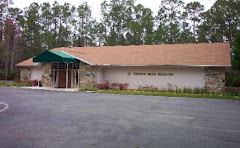
Showing posts with label Beth Shalom. Show all posts

Monday, February 9, 2009

Nazi Forgery Recalled Through Palm Coast Temple Musical Presentation


In the early March 1941, Marriage register no. 60 (1761 – 1762) of the Cathedral Parish Office of Vienna, Austria’s St Stephen’s was officially removed and handed over to the Reichssippenamt (authority dealing with matters of nationality and race) in Berlin, the capital of the the German Third Reich established by Adolf Hitler and his Nazi Party. The reason wasn’t immediately clear until the choir of Temple Beth Shalom in Palm Coast chose to present the operetta “The Waltz King” based on the music of one of Hitler’s favorite composers, Johann Strauss II.
When piano teacher and holocaust survivor Claire Soria brought the libretto to the Temple’s choir director and Moscow Conservatory of Music graduate Marina Lapina, they weren’t sure it was proper to present a Nazi favorite in the sanctuary of a local synagogue. Rabbi Merrill Shapiro sat down to do the research and discovered an interesting irregularity in the biographical history of the Strauss family, an irregularity meant to be covered by a forgery.
Adolf Hitler loved the music of the very Germanic Strauss and, when he was told of the possibility of Strauss’ being a Jew, the Nazi leader shot back with “I will be the decider of who is Jewish and who is not!”
As it turns out, the marriage records of St. Stephen’s Cathedral note the marriage, in 1761 of Johann Michael Strauss, the great-grandfather of the Waltz King who wrote the famous Blue Danube and Emperor Waltzes, was listed as “the worthy Johann Michael Strauss, in service with His Excellency Field Marshal Count von Roggendorf, a baptised Jew, single, born in Ofen, legitimate son of Wolf Strauss and his spouse Theresia, both Jewish!” Johann Strauss II, Hitler’s favorite, was not the pure Aryan ideal of the Nazi regime but rather part Jewish! This would have caused great embarrassment to a leader and a powerful political party dedicated to the destruction of all Jewish bloodlines in Europe.
So, the records were removed, photocopied and altered to eliminate any mention of the Strauss marriage and any mention of his Jewish ancestors. Even the table of contents was altered and then returned with the originals to the Austrian Cathedral. The forged photocopies were placed in the Parish office and the originals were hidden.
Hitler, who was of Austrian birth, personally liked Strauss' music and The Waltz King’s waltzes and operettas were embraced by the Nazi-run cultural apparatus of the Third Reich. In Austria, however, a lot of creative people and ordinary citizens who abhorred the Nazis and the occupying Germans, and who clung to their separate national identity, also embraced Strauss' work as their own, as a statement (veiled and subtle, as it had to be for their own safety) of their separateness from the Germans. Indeed, Strauss' music and the Imperial era that it evoked were a safe haven for the nationalists and anti-Nazis working quietly in the Austrian cities of Vienna and Salzburg. There was the odd, unspoken truth amid all of this, that the Strauss family was of Jewish descent -- in fact, when the Nazis marched in during the spring of 1938, descendants of the composer were protected from persecution by the timely, surreptitious creation of baptismal certificates, indicating conversions to Christianity generations earlier, which conveniently turned up in the public record.
The question of Johann Strauss II’s racial origins and religion is perhaps the most interesting of all, casting a sad and sombre cloud over his heritage given later events after his death in 1899 - and the horrific fate of some of his relatives in the 1930s. Those who assume he was indifferent to his Jewish origins are mistaken. In December 1887, he wrote to his brother-in-law Josef Simon: "I'm not at all sure any more to which religion I belong... although in my heart I am more Jewish than Protestant." These Jewish antecedents of Strauss became particularly problematical for the Nazis when they annexed Austria in 1938. Clearly the subjugation of the Austrian nation could not proceed smoothly if the most popular music of the country was suppressed on racial grounds. Besides, Hitler (who was Austrian himself) loved the music of Strauss. As with Franz Lehr (another Hitler favourite, whose wife, Sophie, was Jewish, but who was made an "honorary Aryan"), Johann Strauss II and his father (who composed the famous Radetzky March, practically a second national anthem in Austria) were to be protected.
What began as a question of whether a Nazi favorite’s music could be played in a local synagogue has come to reveal that the music of Johann Strauss, the :”Waltz King” was written by Strauss the Jew. The embarrassment of the Nazi Reich makes the music that much sweeter to the listeners who will gather at Temple Beth Shalom in Palm Coast at 4 p.m. Sunday, February 22nd. The event is part of a dinner theater afternoon, and the $15 tickets that include the musical and dinner are available to the public through the synagogue office at 386-445-3006.

Sunday, November 2, 2008

Rabbi Hayim Donin’s To Be a Jew, Becomes Adult Education Course at Beth Shalom


Rabbi Hayim Donin’s fundamental work in his classic guide To Be a Jew will become an adult education course at Temple Beth Shalom beginning November 12th. The class will meet regularly on Wednesdays from 1:45 until 2:30 p.m. and will be moderated by Merrill Shapiro, Rabbi of Temple Beth Shalom. All are welcome, there is no charge, no advance arrangements need be made. Because of the nature of the course, no meeting is dependent on previous or future meetings. Thus, each session is stand-alone, participants need make no commitment to regular attendance.  


To Be a Jew is Rabbi Hayim Halevy Donin's classic guide to Jewish life, philosophy, and law has guided generations of Americans, Europeans, and Israelis to discover the treasures of their own religious traditions. First published in 1972, the book still stands as a reliable, practical and versatile resource for everyone from young girls preparing for bat mitzvah to old men returning to their spiritual roots. The book begins with an overview of Judaism's basic credo (including chapters on Israel's people, land, God, and Torah), moves on to describe the laws governing Jews' daily lives, the Jewish calendar, and "The Special Occasions of Life" from birth to death and mourning. One great strength of To Be a Jew is its blending of folk wisdom and scholarly learning. Rabbi Donin not only describes what right belief and righteous action look like but provides a rationale for these observances that engages and embraces the basic conditions of modern life.  

The initial course calendar and subjects to be discussed include:
 
 
November 12 Israel –The People
 
November 19 Israel –Its Land
 
November 26 Israel-Its God
 
December 3 Israel- Its Torah
 
December 10 Halakha: The Jewish Way
 
December 17 The Reasons for the Commandments
 
January 7th Kindness: A Means to an End
 
January 14 acts of Kindness
 
January 21 Laws of Charity
 
January 28 Laws Relating to Slander, Revenge and Deceit

Beth Shalom and Hadassah Offer Modern Spoken Hebrew Classes


Temple Beth Shalom and Palm Coast Hadassah have partnered to offer classes in modern spoken Hebrew through a course called Ivrit L'Hadassah, Hebrew of Hadassah. The classes meet Wednesday afternoons at Temple Beth Shalom  The beginngers course is offered from 3:00 until 3:45 p.m. while a course for intermediate level students is is offered from 1:00 untill 1:45 p.m.  The courses are open to all and there is no charge. Further details are available from the course instructor Merrill Shapiro, the Rabbi of Temple Beth Shalom who can be reached in the synagogue office at 386-445-3006.

The initial course calendar plans meetings on Wednesdays November 12th, 19th and 26th, December 3rd, 10th and 17th and January 7th, 14th 21st and 28th.   

Learning Hebrew is not as hard as one might think. Anyone can learn to read, speak, and understand the language of the Bible, prayers, and of daily life in Israel. Even for those who can't read a single Hebrew letter, or those who already have a background in the language, Ivrit la Hadassah – Hadassah's National Hebrew Studies program – can provide anyone and everyone with the basic building blocks of Hebrew to help build or increase Hebrew Language proficiency. 


Ivrit la Hadassah offers a four-level program that teaches the Hebrew alphabet in segments, integrates grammar sequentially, and introduces conversational Hebrew. Peer-led classes use an exciting, low-pressure, results-oriented approach that emphasizes basic skills and conversational fluency.Participants have fun learning, and make friends who share a  Jewish consciousness and love of Israel.

The gift of Jewish and Hebrew literacy is now available to Flagler County residents.  

Friday, March 21, 2008

Preparing for Passover, Beth Shalom Promotes Israel Wineries


As the season begins for preparations for the traditional observance of the ancient Passover Festival, Palm Coast’s Temple Beth Shalom Men’s Club and Sisterhood are promoting the purchase of the produce of Israel’s wineries by offering bottles of Galilean wine in response to donations of $18.75 or more! The project is designed to encourage the purchase of products from Israel to strengthen the economy of the Middle East’s only genuine democracy and steadfast American ally.

Wine is an essential ingredient to the celebration of Passover, based upon the promises made to the ancient Hebrews in the sixth chapter of the biblical Book of Exodus. The centrality of the use of wine at Passover is verified by the Gospel accounts of the ritual used by Jesus at the Last Supper.

Temple Beth Shalom has made available in Flagler County, wines from the vineyards of the Galilee or Northern Israel region. This region is most suited for viniculture in Israel due to its high elevation, cool breezes, marked day and night temperature changes and rich, well-drained soils (most suitable for Cabernet Sauvignon, Merlot, Sauvignon Blanc and Chardonnay).

Wine has been produced in the Land of Israel since Biblical times. The ancient land of Israel (known at various times as Canaan and Judea) was making wine over two thousand years before Europe. In Biblical times the wine industry was the mainstay of the economy and wine had significant ritual importance.

The city of
Gibeon was the center of wine making in ancient Israel. In 1959 and 1960 archaeological expeditions discovered ancient wine cellars saved and preserved at temperatures of 20 degrees Celsius. Furthermore it has been determined that wine was made and stored in ancient Gibeon between 600 C.E and 700 C.E. Great similarities between the wine cellars of Gibeon, Israel and Champagne, France have been noted, as if the same architect was involved in the design and building of the wine cellars despite the fact that the cellars of Gibeon were built 500 years earlier than the cellars of Champagne, France.

Ancient wines lacked the quality that people have become accustomed to in modern times. They were thick and sweet and had to be seasoned just to make them palatable.


Baron Edmond de Rothschild built two wineries in the final decades of the nineteenth century, one in
Zikhron Ya'aqov and another in Rishon LeZion. Because of high temperatures the wine of the first vintages went sour, so deep underground cellars were constructed at enormous cost.

In 1906 Rothschild passed the management of the wineries onto the growers who formed the Societe Co-operative Vigneronne des Grandes Caves and in 1957 his son, James Rothschild, donated the wineries to the wine growers cooperative. Their vineyards covered many parts of Israel, but the main concentration was in the coastal regions of Sharon & Samson. The resulting wines were sold under the brand name 'Carmel'.
At the turn of the twentieth century Carmel produced the first Israeli wine to win a medal at a wine show (Carmel No. 1 1900 was a gold medal winner at the Paris
World's Fair). It signaled It signaled the rebirth of the Israeli wine industry after 2,000 years.
Well into the 1960s, Israel suffered from a reputation of producing wines too thick and sweet to appeal to true wine connoisseurs. In the 1970s Carmel began to produce Israel's first varietal wines (
Cabernet Sauvignon & Sauvignon Blanc).

Today, some Israeli wines are so good that they are compared favorably to the wines of the respected chateaux of France. Starting in the 1990s and continuing in the 2000s there has been an explosion of new boutique wineries throughout Israel. The most famous of these is Domaine du Castel, situated in the Judean Hills, west of Jerusalem. Castel wines were chosen as Decanter Wine of the Month on no less than three occasions.

Israel wins most prizes for its red wines, in particular Cabernet Sauvignon, but awards have been won for traditional method sparkling wines, white wines & dessert wines too. Eleven different Israeli wineries have won gold medals at the very highest level of international
blind tasting wine competitions at least once, and some are regular winners.

Temple Beth Shalom is proud to present fine Israeli wines to the sophisticated consumers of Flagler County and to support the produce of the Holy Land. Robert Arkin, President of the synagogue’s Men’s Club is quick to point out that “great festivals like Passover, require great wine from a great and holy land, an ancient land made new again in our own time through the modern State of Israel!”

Wednesday, January 16, 2008

Palm Coast Transitions Explained by Mayor Netts at February 10th Temple Breakfast


In just the past 90 days, five Palm Coast city officials have assumed new offices, Vice-Mayor Alan Peterson, re-elected City Council Member Mary DiStefano and two new Council Members, Holsey Moorman and Frank Meeker as well as Mayor Jon Netts who will be the guest speaker at a Temple Beth Shalom Men’s Club Breakfast open to the public on February 10th at 10 a.m. at the congregation’s Wellington Drive synagogue. All are welcome, advance reservations are encouraged but not required. The event includes a sumptuous breakfast for $10 each adult while there is no charge forchildren under the age of 18.

Mayor Jon Netts serves as a Director of the Palm Coast Historical Society; as a Director of Enterprise Flagler, and on the Executive Board of Flagler Habitat for Humanity. He has served as Chairman of the Flagler County's "Citizen Advisory Committee on School Impact Fees" and on the "Flagler County Blue Ribbon Landfill Advisory Committee." He is a graduate of "Leadership Flagler." In November, 2006 Mr. Netts was appointed by Gov. Jeb Bush to the Northeast Florida Regional Planning Council.

The Men’s Club of Temple Beth Shalom has been established to serve the Palm Coast community, enrich the spiritual life of neighbors both near and far. The Men’s Club seeks to create a sense of fellowship and warmth among people of all ages. The Men’s Club of Temple Beth Shalom enjoys the fellowship and kinship that derive from a variety of activities such as celebrating holidays together, laughing together and studying together. Members have found a home away from home where friendly people are always eager and willing to help couples, single parent families, senior adults, interfaith marrieds and newcomers to our community. The Men’s Club makes Temple Beth Shalom, the center of Jewish life in Flagler County, a place where everyone counts!

Tuesday, January 8, 2008

Palm Coast Students Complete Read Hebrew America/Canada Course


Ten Flagler County students were caught up in the National Jewish Outreach Program’s Read Hebrew American event, one of over a 1000 classes across the continent reaching more than 12,000 students intent on acquiring access to the ancient Hebrew documents that guide western civilization. The ten, meeting at Temple Beth Shalom on Thursday evenings, were part of a mega Hebrew literacy campaign that invited thousands of Jewish adults into community institutions to create awareness of the importance of Hebrew literacy. In just five 90 minute sessions, students were given the key to reading with beginning level comprehension the language of the Bible and of a myriad of historical documents dating back 2,500 years.

The National Jewish Outreach Program is an adult education and outreach organization founded in 1987 by Rabbi Ephraim Buchwald, a leading American rabbi then serving at the Lincoln Square Synagogue in midtown Manhattan, New York City. The program’s aim is to address issues of Hebrew and Jewish literacy.

Temple Beth Shalom is the center of Jewish communal life in Flagler County. Founded 35 years ago, the congregation has grown reflecting the growth of Palm Coast. Beth Shalom sees itself as an educational institution intent on fostering the understanding of traditional Judaism, its customs, ceremonies and traditions among both Jews and non-Jews in the region.

Tuesday, September 18, 2007

Flagler Jews Announce Sukkot Service Schedule


The Jewish Community of Flagler County has announced its schedule of services celebrating the Festival of Sukkot, the Feast of Tabernacles also called the Feast of Booths. The Holy Day, ordained by the Biblical Book of Leviticus, Chapter 23, verse 39, "Howbeit, on the fifteenth day of the seventh month, when you have gathered in the fruits of the land, you shall keep the feast of the Lord seven days!" will be ushered in at Temple Beth Shalom on Wednesday evening, September 26th at an 8 p.m. service.

The opening days of the Festival of Sukkot, the basis for the American celebration of Thanksgiving, will be celebrated at special services on Thursday morning and Friday morning, September 27th and 28th. All morning services begin at 9:15 a.m. and are followed by Kiddush refreshements. All are welcome to attend.

The Festival of Sukkot begins on Tishrei 15, the fifth day after Yom Kippur. It is quite a drastic transition, from one of the most solemn holidays in our year to one of the most joyous. Sukkot is so unreservedly joyful that it is commonly referred to in Jewish prayer and literature as Z'man Simchateinu Z'mn Simchateinu (in Hebrew), the Season of our Rejoicing.


Sukkot is the last of the Shalosh R'galim (three pilgrimage festivals). Like Passover and
Shavuot , Sukkot has a dual significance: historical and agricultural. Historically, Sukkot commemorates the forty-year period during which the children of Israel were wandering in the desert, living in temporary shelters. Agriculturally, Sukkot is a harvest festival and is sometimes referred to as Chag Ha-Asif Chag Ha-Asif (in Hebrew), the Festival of Ingathering.


The word "Sukkot" means "booths," and refers to the temporary dwellings that we are commanded to live in during this holiday in memory of the period of wandering. The Hebrew pronunciation of Sukkot is "Sue COAT," but is often pronounced as in Yiddish, to rhyme with "BOOK us." The name of the holiday is frequently translated "Feast of Tabernacles," which, like many translations of Jewish terms, isn't very useful. This translation is particularly misleading, because the word "tabernacle" in the Bible refers to the portable Sanctuary in the desert, a precursor to the Temple, called in Hebrew "mishkan." The Hebrew word "sukkah" (plural: "sukkot") refers to the temporary booths that people lived in, not to the Tabernacle.


Sukkot lasts for seven days. The two days following the festival,Shemini Atzeret and Simchat Torah are separate holidays but are related to Sukkot and are commonly thought of as part of Sukkot. Shemini Atzeret worship at Temple Beth Shalom begin at 9:15 a.m. Thursday, October 4th and include the traditional Yizkor Memorial Service. Simchat Torah services will begin at 7 p.m. on Thursday, October 4th and continue at 9:15 a.m. on Friday, October 5th.


The festival of Sukkot is instituted in Leviticus 23:33 et seq. No work is permitted on the first and second days of the holiday. Work is permitted on the remaining days. These intermediate days on which work is permitted are referred to as Chol Ha-Mo'ed, as are the intermediate days of Passover.

Wednesday, September 5, 2007

Sept. 8 Selichot Concert features Marina Lupina and TBS Choir


The public is invited to a unique Choral Concert at Temple Beth Shalom, Saturday evening, September 8th in the synagogue's sanctuary at 40 Wellington Drive, Palm Coast, Florida 32164. The concert will introduce the traditional Selichot Service at Flagler County's central synagogue and thus help to usher in the High Holy Day season that begins with the eve of Rosh HaShannah, Wednesday evening, September 12th and ends 22 days later with the celebration of Simchat Torah, when the yearly cycle of the reading of the Five Books of Moses is completed and begun anew!


The concert features Chorus Director Marina Lupina a graduate of the reknown Moscow Conservatory of Music. Founded in 1866 by Nikolai Rubinstein, brother of the famous Russian pianist and composer Anton Rubinstein, who founded the St. Petersburg Conservatory in 1862.
At its opening, Tchaikovsky
was appointed professor of theory and harmony, a post he held until approximately 1878. Since 1940, the conservatory has borne Tchaikovsky's name. Notable alumni of the Conservatory include Palm Coasts, Lapina and pianist Boris Berezovsky, composer Dmitry Borisovich Kabalevsky, composer, pianist and conductor Sergei Rachmaninoff and cellist Mstislav Rostropovich.


Lupina has led choirs throughout Europe and North America and taught Choral Conducting. She is currently on the faculty of several colleges and universities in Central Florida.


Selichot are special prayers for forgiveness, properly pronounced "s'lee-KHOHT," but often pronounced "SLI-khus" in Ashkenazi communities. They are usually said on fast days, and also said during the period preceding Yom Kippur. In the Sephardic tradition, Selichot are said beginning with the month of Elul, through Yom Kippur to help worshipers direct their hearts and minds to the process of teshuvah, repentance. At the Selichot service, worshipers begin to examine their deeds of the past year, seeking forgiveness from God, and promising to improve their behavior in the New Year. In the Ashkenazic tradition, Selichot are begun at a time such that there will be ten daily opportunities for their recitation before and including Yom Kippur. This is based on the custom, once prevalent, that Jews would fast for ten days (eating at night) before and including Yom Kippur.


In general, the proper time to say Selichot are at the end of the night, just before the morning, since this time is considered, according to Jewish Mysticism, a specially favorable time, in terms of the presence and closeness of God. Hence, selichot are typically recited in the early morning, before the daily Shacharit service. They add about 45 minutes to the regular daily service.
Selichot are recited from the Sunday before Rosh Hashannah until Yom Kippur. If Rosh Hashannah begins on a Monday or Tuesday, selichot begins on the Sunday of the week before Rosh Hashannah, to make sure that there are at least three days of Selichot. The first selichot service of the holiday season is usually a large community service, held around midnight on Motzaei Shabbat (the night after the sabbath ends; that is, after nightfall on Saturday). The entire community, including men, women and older children, attend the service, and the rabbi gives a sermon.


The first night of Selichot is different from the other days. First, it is customary to say Selichot the first night before going to sleep, and, since the first part of the night is considered a time of din, judgment, the Selichot are not recited on the first night until after chatzot, relative midnight. A person should consult a Jewish Calendar or their Rabbi to determine the specific time of chatzot for their area.


A fundamental part of the selichot service is the repeated recitation of the "Thirteen Attributes," a list of God's thirteen attributes of mercy that were revealed to Moses by G-d after the sin of the golden calf (Exodus 34:6-7): "Hashem, [1], Ha-shem [2], G-d [3], merciful [4], and gracious [5], long-suffering [6], abundant in goodness [7] and truth [8], keeping mercy unto the thousandth generation [9], forgiving iniquity [10] and transgression [11] and sin [12], who cleanses [13]." Why is "Ha-shem" listed twice as an attribute? And why are three of these "attributes" Names of G-d? Different names of G-d connote different characteristics of Him. The four-letter Name of G-d (rendered here as "Ha-shem," literally "the name") is the Name used when G-d is exhibiting characteristics of mercy, and the Talmud explains that this dual usage indicates that G-d is merciful before a person sins, but is also merciful after a person sins. The third attribute is a different Name of G-d that is used when G-d acts in His capacity as the almighty ruler of nature and the universe. G-d appeared to Moses and taught him these Thirteen Attributes saying, "Whenever Israel sins, let them recite this in its proper order and I will forgive them." Thus, this appeal to G-d’s mercy reassures that repentance is always possible, and that G-d always awaits a return to Him. The implication is also that if people emulate G-d’s merciful ways, He will treat them mercifully in return.