Showing posts with label Jews. Show all posts

Tuesday, September 18, 2007

Flagler Jews Announce Sukkot Service Schedule


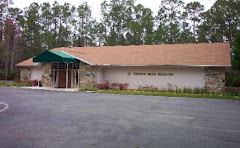
The Jewish Community of Flagler County has announced its schedule of services celebrating the Festival of Sukkot, the Feast of Tabernacles also called the Feast of Booths. The Holy Day, ordained by the Biblical Book of Leviticus, Chapter 23, verse 39, "Howbeit, on the fifteenth day of the seventh month, when you have gathered in the fruits of the land, you shall keep the feast of the Lord seven days!" will be ushered in at Temple Beth Shalom on Wednesday evening, September 26th at an 8 p.m. service.

The opening days of the Festival of Sukkot, the basis for the American celebration of Thanksgiving, will be celebrated at special services on Thursday morning and Friday morning, September 27th and 28th. All morning services begin at 9:15 a.m. and are followed by Kiddush refreshements. All are welcome to attend.

The Festival of Sukkot begins on Tishrei 15, the fifth day after Yom Kippur. It is quite a drastic transition, from one of the most solemn holidays in our year to one of the most joyous. Sukkot is so unreservedly joyful that it is commonly referred to in Jewish prayer and literature as Z'man Simchateinu Z'mn Simchateinu (in Hebrew), the Season of our Rejoicing.


Sukkot is the last of the Shalosh R'galim (three pilgrimage festivals). Like Passover and
Shavuot , Sukkot has a dual significance: historical and agricultural. Historically, Sukkot commemorates the forty-year period during which the children of Israel were wandering in the desert, living in temporary shelters. Agriculturally, Sukkot is a harvest festival and is sometimes referred to as Chag Ha-Asif Chag Ha-Asif (in Hebrew), the Festival of Ingathering.


The word "Sukkot" means "booths," and refers to the temporary dwellings that we are commanded to live in during this holiday in memory of the period of wandering. The Hebrew pronunciation of Sukkot is "Sue COAT," but is often pronounced as in Yiddish, to rhyme with "BOOK us." The name of the holiday is frequently translated "Feast of Tabernacles," which, like many translations of Jewish terms, isn't very useful. This translation is particularly misleading, because the word "tabernacle" in the Bible refers to the portable Sanctuary in the desert, a precursor to the Temple, called in Hebrew "mishkan." The Hebrew word "sukkah" (plural: "sukkot") refers to the temporary booths that people lived in, not to the Tabernacle.


Sukkot lasts for seven days. The two days following the festival,Shemini Atzeret and Simchat Torah are separate holidays but are related to Sukkot and are commonly thought of as part of Sukkot. Shemini Atzeret worship at Temple Beth Shalom begin at 9:15 a.m. Thursday, October 4th and include the traditional Yizkor Memorial Service. Simchat Torah services will begin at 7 p.m. on Thursday, October 4th and continue at 9:15 a.m. on Friday, October 5th.


The festival of Sukkot is instituted in Leviticus 23:33 et seq. No work is permitted on the first and second days of the holiday. Work is permitted on the remaining days. These intermediate days on which work is permitted are referred to as Chol Ha-Mo'ed, as are the intermediate days of Passover.

Sunday, September 9, 2007

Flagler Jewish Students Seek Holy Day Absence Clarifications

As the High Holy Days approach, Flagler County Public Schools' Jewish students, with the help of Temple Beth Shalom and Rabbi Merrill Shapiro have turned to Superintendent Bill Delbrugge for clarification of the system's excused absence policy. State of Florida Statutes Chapter 1003.21 and Flagler County School Board Policy 533 provide that "Students may be excused from school for observance of established religious holidays or for religious instruction."

Making the statutes and the policy well-known is part of an effort to bring young people into the sanctuary of Temple Beth Shalom on Rosh HaShannah! But questions still remain.

Among the questions raised by Rabbi Shapiro in a letter to Superintendent Delbrugge are issues of practical application. On behalf of Jewish students in the Flagler School system, Delbrugge has been asked if Policy 533 means that students will, in some way be penalized by make-up tests and quizzes that are more difficult than original tests and quizzes. Will assignments due on the two days of Rosh HaShannah, Thursday, September 13th and Friday, September 14th be accepted on the first day students return to school, Monday, September 17th? Will assignments made on September 13th and 14th be communicated to students? Will students who attend services, devoting themselves to sacred Jewish traditions be rendered ineligible for attendance awards?

Shapiro, on behalf of the Jewish community expressed support for Flagler Public Schools and a willingness to help in any way possible. Many students and their families have been urged to avail themselves of the rights and privileges granted by Board Policy 533 and by Florida Statutes. The voices of young people in the midst of a worshipping Jewish congregation always bring joy and delight to the faithful gathered to celebrate Jewish Holy Days!

Wednesday, September 5, 2007

Sept. 8 Selichot Concert features Marina Lupina and TBS Choir


The public is invited to a unique Choral Concert at Temple Beth Shalom, Saturday evening, September 8th in the synagogue's sanctuary at 40 Wellington Drive, Palm Coast, Florida 32164. The concert will introduce the traditional Selichot Service at Flagler County's central synagogue and thus help to usher in the High Holy Day season that begins with the eve of Rosh HaShannah, Wednesday evening, September 12th and ends 22 days later with the celebration of Simchat Torah, when the yearly cycle of the reading of the Five Books of Moses is completed and begun anew!


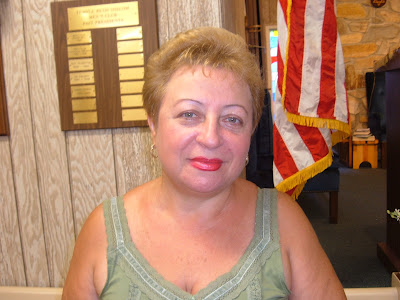
The concert features Chorus Director Marina Lupina a graduate of the reknown Moscow Conservatory of Music. Founded in 1866 by Nikolai Rubinstein, brother of the famous Russian pianist and composer Anton Rubinstein, who founded the St. Petersburg Conservatory in 1862.
At its opening, Tchaikovsky
was appointed professor of theory and harmony, a post he held until approximately 1878. Since 1940, the conservatory has borne Tchaikovsky's name. Notable alumni of the Conservatory include Palm Coasts, Lapina and pianist Boris Berezovsky, composer Dmitry Borisovich Kabalevsky, composer, pianist and conductor Sergei Rachmaninoff and cellist Mstislav Rostropovich.


Lupina has led choirs throughout Europe and North America and taught Choral Conducting. She is currently on the faculty of several colleges and universities in Central Florida.


Selichot are special prayers for forgiveness, properly pronounced "s'lee-KHOHT," but often pronounced "SLI-khus" in Ashkenazi communities. They are usually said on fast days, and also said during the period preceding Yom Kippur. In the Sephardic tradition, Selichot are said beginning with the month of Elul, through Yom Kippur to help worshipers direct their hearts and minds to the process of teshuvah, repentance. At the Selichot service, worshipers begin to examine their deeds of the past year, seeking forgiveness from God, and promising to improve their behavior in the New Year. In the Ashkenazic tradition, Selichot are begun at a time such that there will be ten daily opportunities for their recitation before and including Yom Kippur. This is based on the custom, once prevalent, that Jews would fast for ten days (eating at night) before and including Yom Kippur.


In general, the proper time to say Selichot are at the end of the night, just before the morning, since this time is considered, according to Jewish Mysticism, a specially favorable time, in terms of the presence and closeness of God. Hence, selichot are typically recited in the early morning, before the daily Shacharit service. They add about 45 minutes to the regular daily service.
Selichot are recited from the Sunday before Rosh Hashannah until Yom Kippur. If Rosh Hashannah begins on a Monday or Tuesday, selichot begins on the Sunday of the week before Rosh Hashannah, to make sure that there are at least three days of Selichot. The first selichot service of the holiday season is usually a large community service, held around midnight on Motzaei Shabbat (the night after the sabbath ends; that is, after nightfall on Saturday). The entire community, including men, women and older children, attend the service, and the rabbi gives a sermon.


The first night of Selichot is different from the other days. First, it is customary to say Selichot the first night before going to sleep, and, since the first part of the night is considered a time of din, judgment, the Selichot are not recited on the first night until after chatzot, relative midnight. A person should consult a Jewish Calendar or their Rabbi to determine the specific time of chatzot for their area.


A fundamental part of the selichot service is the repeated recitation of the "Thirteen Attributes," a list of God's thirteen attributes of mercy that were revealed to Moses by G-d after the sin of the golden calf (Exodus 34:6-7): "Hashem, [1], Ha-shem [2], G-d [3], merciful [4], and gracious [5], long-suffering [6], abundant in goodness [7] and truth [8], keeping mercy unto the thousandth generation [9], forgiving iniquity [10] and transgression [11] and sin [12], who cleanses [13]." Why is "Ha-shem" listed twice as an attribute? And why are three of these "attributes" Names of G-d? Different names of G-d connote different characteristics of Him. The four-letter Name of G-d (rendered here as "Ha-shem," literally "the name") is the Name used when G-d is exhibiting characteristics of mercy, and the Talmud explains that this dual usage indicates that G-d is merciful before a person sins, but is also merciful after a person sins. The third attribute is a different Name of G-d that is used when G-d acts in His capacity as the almighty ruler of nature and the universe. G-d appeared to Moses and taught him these Thirteen Attributes saying, "Whenever Israel sins, let them recite this in its proper order and I will forgive them." Thus, this appeal to G-d’s mercy reassures that repentance is always possible, and that G-d always awaits a return to Him. The implication is also that if people emulate G-d’s merciful ways, He will treat them mercifully in return.