Tuesday, January 8, 2008

Sdeh Shalom Program Brings Afternoon Worship to Flagler County


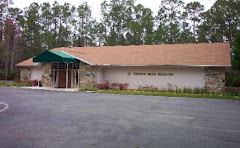
As the sun began to set in the western sky, 17 members of the local Jewish community gathered to take a moment out to acknowledge the presence of the Almighty in northwest Flagler County. Temple Beth Shalom is offering an afternoon Mincha service each and every Tuesday at 5:30 p.m. at the congregation’s Sdeh Shalom site on Old Kings Road, just north of Matanzas High School. All are welcome to attend. Mincha is an oasis of spiritual time in a tough day, a moment of calming nerves and focusing on priorities.
Jews are bidden to pray three times daily to God. The Shacharit prayer takes place in the morning. It is the longest of the three daily prayers and contains within it the basic affirmations of Judaism -- the Shema, the Amidah and the ideas of repentance, self-improvement and loyalty to God and Israel.
The Maariv prayer takes place at night, after sunset. It is much shorter in length than Shacharit, but nevertheless includes again within it the basic Shema and Amidah prayers.
The shortest prayer service of the day takes place in the afternoon, or at least just before sunset, and is called Mincha. It is composed of the recitation of Psalm 145, the Amidah, a prayer of repentance and the concluding prayer to all Jewish prayer services, Aleynu. Aleynu is a reaffirmation of Jewish goals and a hope for the better world for all humankind.
Mincha is usually a 10-to-15-minute prayer service, but for much of the Jewish world, it has become almost a forgotten prayer service. It is not the length of Mincha that has caused this, but rather its inconvenience in coming in the middle of a busy working afternoon. But in that fact alone lies perhaps its major importance and necessity.
IN THE FIELD
Our Sages attribute the origin of our three daily prayer services to our patriarchs, Abraham, Isaac and Jacob. Abraham created the prayer time for Shacharit, Isaac for Mincha and Jacob for Maariv.
The rabbis of the Talmud deduced the role of Isaac in creating Mincha from the verse in the Torah that tell us that "Isaac went out to converse in the field" (Genesis 24:63-65). Converse with who? The Torah itself is silent on the subject. The rabbis are of the opinion that the conversation was between Isaac and God. And since the Torah describes this event as happening "before evening," Jewish tradition placed the time of Mincha as being in the afternoon before the time of the sun setting.
Mincha is also connected with being "in the field." Shacharit and Maariv are possible to be prayed outside of the time constraints of our mundane everyday tasks. Not so Mincha. It stops us in the middle of work, shopping, school, and all other usual tasks that life places upon us. It meets us "in the field," at our desks and in our factories -- and it is always inconvenient. But it is an oasis of spiritual time in a tough workday, a moment of contemplation, a calming of nerves and a focusing of priorities. As such, it is perhaps the most important and meaningful prayer service of the day.
NEIGHBORHOOD GROUPS
Today, there are many "Mincha" prayer groups in companies, stores, colleges, hospitals and in geographic areas of cities where a considerable number of observant Jews are to be found.
A lawyer many decades ago in downtown Chicago, observes that there were few if any such "Mincha" prayer groups. He would lock myself in his office, tell his secretary that he was making an important private call, and pray. (Yes, he was placing a personal call to the Almighty.) . Many times he felt a sense of rejuvenation and exhilaration after this 15-minute prayer break. It helped him to overcome the disappointments and frustrations that are the daily lot of all of us at our places of work.
What is lacking in much of current Jewish life, even amongst those who are nominally affiliated with synagogues or Jewish organizations, is a sense of personal participation in Judaism, its rituals, values and blessings. There are members but not participants. No sermon, article, book, class, etc. can connect one to being truly Jewish and feeling so in one's inner soul to the extent that a simple Mincha prayer in the midst of a busy afternoon at the office can.
Mincha becomes a major component of experiencing spirit and holy transcendence in daily human life. It can literally change the way we think about people, the world, life, ourselves

Palm Coast Students Complete Read Hebrew America/Canada Course


Ten Flagler County students were caught up in the National Jewish Outreach Program’s Read Hebrew American event, one of over a 1000 classes across the continent reaching more than 12,000 students intent on acquiring access to the ancient Hebrew documents that guide western civilization. The ten, meeting at Temple Beth Shalom on Thursday evenings, were part of a mega Hebrew literacy campaign that invited thousands of Jewish adults into community institutions to create awareness of the importance of Hebrew literacy. In just five 90 minute sessions, students were given the key to reading with beginning level comprehension the language of the Bible and of a myriad of historical documents dating back 2,500 years.

The National Jewish Outreach Program is an adult education and outreach organization founded in 1987 by Rabbi Ephraim Buchwald, a leading American rabbi then serving at the Lincoln Square Synagogue in midtown Manhattan, New York City. The program’s aim is to address issues of Hebrew and Jewish literacy.

Temple Beth Shalom is the center of Jewish communal life in Flagler County. Founded 35 years ago, the congregation has grown reflecting the growth of Palm Coast. Beth Shalom sees itself as an educational institution intent on fostering the understanding of traditional Judaism, its customs, ceremonies and traditions among both Jews and non-Jews in the region.

Tuesday, December 11, 2007

Celebrating Channukah at Beth Shalom


Celebrating Channukah at Beth Shalom

Chanukah comes from the Jewish word chinuch, meaning education. The story of Chanukah is the story of the struggle for Jewish chinuch versus Greek education. The outcome was victory for the Jews against a foreign enemy and a foreign education.
We might think that since we won, we have continued with our educational successes. But unfortunately today we see many examples of educational failures throughout the Jewish community. As children reach their late teens, they sometimes opt to leave their parents' heritage and instead abandon themselves to the prevalent pop culture of the streets. Many fall into drugs, ruining their lives and grieving their parents.
Much of this could have been avoided if the parents had given their children correct roadmaps for mapping out their lives. Temple Beth Shalom and its substantial investment in its Religious School works to create and make accessible those roadmaps that help children and their parents find their way.
A road map is something we are all familiar with. Before starting out on a long journey into an area that we are unfamiliar with, we get a map. As we drive we compare the real roads that we are on to the lines on the road map.
Generally road maps are correct and by following the various lines on the map we safely arrive at our destination. However it does happen that even though we are following the map, we still get lost. The information on the map is not correct because it does not correctly reflect the reality of the land. Either new roads have been built or old ones have been moved. If we are using a map and we see that it does not help us, but it only confuses us, we will abandon it and find a different way of getting to our destination.
Also a particular road map may be correct for certain modes of transportation, but not for others. The standard roadmap may be fine for a passenger car, but not for a hiker. For a hiker, it may be very dangerous to assume that walking from one place to another will be across flat land. He may in reality jeopardize his hike by walking through dangerous rivers and canyons.
Likewise as roadmap for a passenger car may not be accurate for a helicopter that must go from one location to another. It does not show mountain peaks and airports.
Similarly, when parents try to educate their children, they must realize that the child knows nothing about the reality of life. Children at an early age look to the parents to guide them. If the parent provides proper guidance for the child, then the chances of the child leaving the parents heritage and going into bad and dangerous directions is minimal. But there are several factors that must be taken into consideration.
First, is the direction set forth by the parent for the child proper for that particular child? Children are individuals; even in one family one child may have a personality that will lead him in a direction different from his siblings. He may have strengths and advantages are quite different from his peers. Has the parent taken this into consideration before setting out the roadmap for the child?
The parent must relate to the child as an individual and not as someone that must be molded to a group. Groups may be fine for various social and educational opportunities, but the child's individuality should not be subjugated to a group identity that is not in keeping with the child's unique personality.
Secondly, are the goals and direction in which the child is pointed correct for this particular child? Each child is a unique being and requires being guided in a direction that is proper for him. To send a child in a direction that is not fitting for his personality, is asking for the child to rebel.
In addition, a warm and concerned parent who listens to the child and tries to understand the child's problems is a prerequisite for all parents. Parents must have their child's future and needs in their hearts and not those of the various peer groups.
When parents provide a viable roadmap individually tailored for each particular child, they not only will be doing their child a great service, but their child will always love and respect the parents for it. This is the meaning of (Proverbs 22:6) "Educate the youth in accordance to his manner, and even when he grows old he will not abandon it."
Those gains that we made on Chanukah should not be lost, whether we speak of a group or of an individual. Celebrating Chanukah at Temple Beth Shalom is a sacred task arming and empowering families to convey their precious Jewish heritage, generation after generation.

Beth Shalom Students Rise to a New Level Celebrating Siyum


Beth Shalom Students Rise to a New Level Celebrating a Siyum

As Temple Beth Shalom students complete a thorough review of the strategies and methodologies of Hebrew reading, they have celebrated a Siyum, a completion and prepare to move on to access ancient Biblical texts, far older than the English language! Under the guidance of Religious School Principal Robyn Shapiro, students have been studying and submitted to rigorous testing. All of the students passed their oral comprehensive Hebrew reading tests with flying colors and are working on the reading of Biblical texts, especially those from the Books of Exodus and Psalms. Thus, they have acquired and are putting to use skills to delve into literature written some 2,700 years ago!

Technically speaking, a siyum (“completion”) means the completion of any unit of Torah study, or book of the Mishnah or Talmud in Judaism. A siyum is usually followed by a celebratory meal, or seudat mitzvah, a meal in honor of a mitzvah, or commandment. Siyum also refers to the celebration.

It has become customary for synagogues to arrange a siyum on the morning before Passover to allow those fasting for Ta’anit Bechorim (Fast of the Firstborn to break their fast, taking advantage of the halachic principle that prioritizes Torah study. A siyum ha-sefer, meaning “completion of the book,” is also held as a ceremonial completion and dedication of a sefer Torah, a handwritten copy of the Torah, the most important Jewish ritual object, which is kept in the Ark of a synagogue. Usually, when an individual or a group conclude the study of any tractate of the Talmud, or even of the Mishnah, a siyum is celebrated. At the end of every volume of the Talmud a special hadran prayer is printed with a set order of prayers and a special kaddish in honor of the completion of that volume, which Judaism considers to be an important achievement and a milestone worth celebrating.

In the merit and honor of a deceased individual, it is customary to undertake Mishnah study with the goal of holding a siyum. Rabbi Moshe Feinstein, based on the Nemukei Yosef, the Ran (Rabbeinu Nissim), the Rashbam, and the Eliyah Rabbah, extends the concept of a siyum to include even a festive meal celebrating the completion of any mitzvah (commandment) that has taken a significant duration of time (such as a number of weeks or months). Thus the applicablity to the students of Temple Beth Shalom, the synagogue and Jewish educational institution of Flagler County, Florida.

Thursday, November 29, 2007

Violet Drexler, Flagler County Delegate to Republican National Conventio to Meet with Temple Beth Shalom Teens


Dr. Drexler, Flagler County Delegate to Republican National Convention, to Meet With Temple Beth Shalom Teens

Violet Drexler, Ph.D. one of the two longest serving members of the Flagler County Republican Executive Committee will meet with area teenagers at Temple Beth Shalom on Tuesday evening, December 4th from 7 until 8 p.m. Community teens, parents and friends are welcome to attend. There is no charge, no advance reservations are necessary and refreshments will be available for sale to benefit the Susan G. Komen Race for the Cure.

Drexler who was a Graduate Professor of Education at New York University, will represent area Republicans at the Republican National Convention from September 1 through September 4 in Minneapolis, Minnesota. She represented county Republicans at their national convention in Philadelphia, Pennsylvania in 2000 and has served the local and Florida Republican parties in a variety of capacities since 1989. She taught at both Hunter College and Manhattan Community College in New York City before her retirement.

Temple Beth Shalom teens, still reeling from the murder of a fellow student at Flagler Palm Coast High School have been interested in issues relating to gun control and sought to get some answers from local political leaders. They also are looking forward to asking questions about the War in Iraq, immigration and health care. The teens, through their youth group, called Yad B’Yad--Hebrew for “Hand in Hand,” are learning that, despite their youth, they can have great influence over the upcoming election. The group is sponsored by Temple Beth Shalom and oversight comes from synagogue educator Robyn Shapiro.

Thursday, November 15, 2007

Palm Coast Rabbi Heads to Washington to Lobby


Palm Coast Rabbi Heads to Washington to Lobby for

Workplace Religious Freedom Act


Should police officers be sued if they refuse, on religious grounds, to guard a women’s health clinic where abortions are performed? Must a hospital continue to employ a nurse who tells patients AIDS is contracted because God “doesn’t like the homosexual?” Can a drugstore fire a pharmacist who refuses, because of his religious beliefs, to fill prescriptions for the “morning after” pill?

As the Workplace Religious Freedom Act comes before the United States House of Representatives, Palm Coast’s Rabbi Merrill Shapiro and his wife Robyn, headed for Capitol Hill to lobby, under the auspices and arrangements of Americans United for Separation of Church and State, in the office of Congressman John Mica. In a meeting in the Congressman’s office, the Shapiros spoke of the cornerstones of American society, religious freedom and religious pluralism. “Because of this freedom, each of us has the right to practice, or not practice, the religion of our choice or no religion at all,” Robyn Shapiro, told Brian Waldrip, the eight-term congressman’s Legislative Director, “Yet each of us also should have a right to be able to work!”

The Shapiros and Americans United for Separation of State, feel that the current language of the Workplace Religious Freedom Act is much too broad and will unduly restrain employers who find themselves with employees who refuse to perform their jobs by virtue of their claim of religious freedom. “The law should be written to protect those who wear certain religious garb, such as turbans or burkas and to protect those who need reasonable time off for the celebration of religious holy days, “ Rabbi Shapiro maintains, “but not to protect practices that would harm fellow employees, clients, customers and patients.”

The Shapiros were pleased with the response to their arguments, but remain concerned about the legislation and its potential impact. “All in all, weighing in with our representative in the Congress of the United States, is an especially satisfying practice of the democratic principles that make this country great!” the Shapiros agreed.

Sunday, November 4, 2007

Flagler Democratic Chairman Courtney to Teens: "There are plenty of roles for you to play!"


Flagler County Democratic Party Chairman Doug Courtney told a group of teens gathered with their parents at Palm Coast's Temple Beth Shalom that there are plenty of roles for young people, including those not yet old enough to vote, to play in the electoral process. "Most successful ideas come from one person in whom a fire burns to get something done," Courtney, who also heads the campaign to elect a Democrat to the U.S. House of Representatives from Florida's Seventh Congressional District, told those gathered under the auspices of Yad B'Yad, the Jewish teen group of Flagler County. "If you wish to get something done, just get involved!" he added.


The teens raised issues about gun control, same-sex marriage, child support laws, the Iraq War and the issue of the January 29th Presidential Primary at the hour-long session.